

Most Las Vegas homeowners start asking this question when they run out of space but do not want to move.
Maybe you need a bedroom for a parent moving in. Maybe you want a home office that is actually separate from the rest of the house. Maybe your family grew and your current floor plan just does not work anymore.
Whatever the reason, a home addition is one of the biggest investments you will make in your property. And in Las Vegas, the costs look different from what most national guides show.
This guide gives you real 2026 pricing based on what home additions actually cost in Clark County. No vague national averages. No guesswork. Just honest numbers by project type, what drives cost up or down in Las Vegas specifically, and what you need to know about permits and HOA approval before you start.
By the end of this article you will know exactly what your project should cost and what questions to ask before you hire anyone.
Ready to get a real number for your home? Call (702) 420-2836 for a free in-home estimate anywhere in the Las Vegas Valley.
Home Addition Cost in Las Vegas by Project Type
Las Vegas home addition costs run higher than national averages. Clark County labor rates, HOA review requirements, tile roof tie-ins, and desert-specific construction methods all push costs above what you will see on generic cost calculators built around national data.
Here is what home additions actually cost in Las Vegas in 2026.
| Project Type | Cost in Las Vegas 2026 |
|---|---|
| Single-story addition, mid-range finishes | $250 to $450 per sq ft |
| Two-story addition, mid-range finishes | $225 to $400 per sq ft |
| Bedroom addition, single story | $80,000 to $150,000 |
| Primary suite addition | $110,000 to $260,000 |
| Second-story addition | $200,000 to $480,000 |
| Detached casita (400 to 800 sq ft) | $200,000 to $450,000 |
| Garage conversion to living space | $30,000 to $80,000 |
| Sunroom addition | $25,000 to $75,000 |
Prices vary based on scope, finishes, HOA requirements, and existing home conditions. Free written quote on every project. Call (702) 420-2836
Single-Story Addition
A single-story addition is the most common home addition in Las Vegas. You push out the back or side of the home, add square footage on the ground level, and tie into the existing structure.
In Las Vegas, single-story additions cost between $250 and $450 per square foot for mid-range finishes. A 300 square foot bedroom addition runs $75,000 to $135,000 fully completed. A 500 square foot family room or primary suite addition runs $125,000 to $225,000.
The wide range comes down to finish quality, how much the existing plumbing and electrical need to extend into the new space, and whether the existing tile roof ties in cleanly. Las Vegas tile roofs are beautiful but expensive to match and extend correctly. Budget extra for roof tie-in work on any attached addition.
Second-Story Addition
A second-story addition adds an entirely new floor above your existing home. These are complex projects that require structural engineering to confirm the existing foundation and walls can carry the added load.
In Las Vegas, second-story additions cost between $200,000 and $480,000 depending on the square footage, scope, and finish level. Most Las Vegas homes built after 1990 were not engineered for a second story. A structural engineer must assess the foundation and first-floor framing before any design work begins.
Second-story additions also require full HOA approval in most planned communities across Summerlin, Henderson, Green Valley, and Mountain’s Edge. HOA design review in these communities typically takes 30 to 90 days after formal submission.
Detached Casita
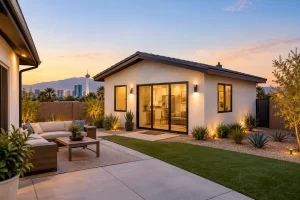
A detached casita is a separate structure built in the backyard. It has its own foundation, its own roof, and its own systems. It does not tie into the main house roof or existing HVAC which avoids two of the most expensive and complicated parts of an attached addition.
Casitas cost between $200,000 and $450,000 in Las Vegas for a 400 to 800 square foot unit. They are popular in Henderson, Summerlin, and Green Valley as guest suites, home offices, in-law accommodations, and rental income units.
A detached casita also sidesteps the tile roof tie-in problem entirely. That alone can save $15,000 to $30,000 compared to an attached addition of similar size. The main constraint is lot size. Most standard Las Vegas lots run 5,000 to 7,000 square feet. A 400 to 600 square foot casita fits on most lots.
Garage Conversion
Converting an existing attached garage to a living space is the most affordable home addition option in Las Vegas. Because the foundation, roof, and walls already exist, the structural work is minimal.
Garage conversions in Las Vegas cost between $30,000 and $80,000 depending on the level of finish, whether a bathroom is added, and how much insulation and HVAC work is needed. Las Vegas garages reach extreme temperatures in summer. Proper insulation and a dedicated HVAC zone are not optional in our climate. Budget $8,000 to $15,000 for insulation and HVAC alone if converting a garage.
Clark County requires a permit for any garage conversion to living space. The converted space must meet residential building codes for insulation, egress windows, electrical, and ceiling height.
What Drives Home Addition Cost Up or Down in Las Vegas
Two Las Vegas homeowners can plan the same size addition and get quotes $80,000 apart. Here is exactly why that happens and what you can control before you start.
HOA Approval Requirements
If your home is in Summerlin, Henderson, Green Valley, Mountain’s Edge, Inspirada, Aliante, or any other master-planned community in Clark County, your HOA controls what you can build before the county does. Some HOAs restrict addition height. Some require specific exterior materials that match the existing home exactly. Some require roof pitches that match the original structure. Some do not allow second-story additions at all.
HOA design review in Las Vegas typically takes 30 to 90 days after formal submission. Get a copy of your CC&Rs and read the section on exterior modifications before you hire anyone. Call your HOA directly and describe what you are planning. Many Las Vegas HOAs will give you informal feedback before a formal submission. That one conversation can save you from designing something they would never approve.
Tile Roof Tie-In
Las Vegas homes have tile roofs. Tying a new addition roof into an existing tile roof is one of the most expensive and technically demanding parts of any attached home addition in the Las Vegas Valley.
Matching the existing tile color and profile is difficult. Manufacturers discontinue tile lines. Sun bleaches existing tiles over years. Even a perfect color match looks slightly off after a few months of desert exposure.
A proper tile roof tie-in on a Las Vegas addition adds $15,000 to $35,000 to the project cost depending on the size of the new roofline and how complex the connection point is. Any contractor who quotes you a Las Vegas addition without specifically pricing the roof tie-in is leaving a major cost out of your estimate.
Foundation Type and Soil Conditions
Las Vegas sits on desert soil with varying compaction. Some areas of the valley have expansive soils that shift with moisture changes. North Las Vegas and parts of Henderson have known soil issues that require deeper footings or engineered foundation solutions.
A standard slab-on-grade foundation for a single-story addition runs $8,000 to $18,000 depending on size. An engineered foundation with deeper footings due to soil conditions can run $20,000 to $40,000. A soils report from a geotechnical engineer costs $1,500 to $3,500 and is worth every dollar before you start any addition project in Las Vegas.
HVAC Sizing and Desert Heat
A home addition in Las Vegas is not just adding square footage. It is adding heat load that your existing HVAC system may not be able to handle.
Las Vegas summers regularly hit 110 degrees or higher. An addition that is not properly cooled is unusable for four to five months of the year. Most Las Vegas homes built before 2010 have HVAC systems already working at full capacity in summer. Adding 300 to 500 square feet often requires either a new dedicated mini-split system for the addition or a full HVAC upgrade for the entire home.
A dedicated mini-split for an addition runs $3,500 to $8,000 installed. A full HVAC upgrade for the main home runs $8,000 to $18,000. Neither of these costs shows up in a per-square-foot estimate unless your contractor specifically includes them.
Plumbing and Electrical Extensions
Adding a bathroom or kitchen to a home addition requires extending the existing plumbing. In Las Vegas, concrete slab foundations mean the water supply and drain lines run under the slab. Getting to those lines requires cutting through the concrete, which adds $3,000 to $8,000 just for that work before any plumbing fixtures are installed.
Electrical panel upgrades are another hidden cost. Many older Las Vegas homes in North Las Vegas and Henderson have 100 or 150 amp panels that are already maxed out. Adding an addition with dedicated circuits often requires a panel upgrade to 200 amps. That costs $2,500 to $5,000 before the addition wiring even starts.
Permit Fees in Clark County
Clark County requires permits for every home addition. Permit fees in Clark County are calculated as a percentage of the project value. For a $150,000 home addition, total permit fees typically run $2,500 to $5,000. For a $300,000 addition they run $5,000 to $9,000. Your contractor should include permit fees in the written estimate from day one.
Finish Level
Finish level is the most controllable cost factor in any Las Vegas home addition. The structure costs what it costs. But the tile, flooring, fixtures, cabinetry, and countertops inside the addition can range from $15,000 to $80,000 for the same size space depending on your choices.
In Las Vegas, the finishes you choose should match the existing home. An addition with finishes far above or below the rest of the house creates a disconnected feel that buyers notice when you sell. Match what you have or upgrade the whole home together.
Permits and HOA Approval for Home Additions in Las Vegas
This is the section most Las Vegas homeowners skip over when planning a home addition. It is also the section that causes the most delays, the most budget surprises, and the most legal headaches after the project is done.
HOA Approval Comes Before Everything Else
If your home is in a master-planned community in Las Vegas, HOA approval comes before Clark County permits. Before architect drawings. Before contractor quotes. Before anything.
Building an addition without HOA approval in a community that requires it is a violation of your CC&Rs. Your HOA can require you to tear down the addition at your own expense. That has happened to Las Vegas homeowners.
Here is the correct order of operations for any HOA community in Las Vegas.
Read your CC&Rs first. Find the section on exterior modifications and additions. Understand exactly what your HOA allows before you spend money on design work.
Contact your HOA architectural review committee second. Describe your project informally. Most Las Vegas HOAs will give you verbal guidance before you submit formal plans.
Submit your formal HOA application third. This typically requires preliminary drawings showing the addition footprint, elevation views, exterior materials, and roof pitch. HOA review takes 30 to 90 days.
Only after HOA approval do you move to Clark County permits.
Which Las Vegas Communities Require HOA Approval
Nearly every master-planned community in the Las Vegas Valley requires HOA approval for home additions.
Summerlin communities including The Vistas, The Paseos, The Ridges, Summerlin Centre, and Sun City Summerlin all have active architectural review processes.
Henderson communities including Green Valley, Green Valley Ranch, Anthem, Seven Hills, and Inspirada require HOA approval and often have stricter design standards than other areas of Clark County.
North Las Vegas communities including Aliante require formal HOA review for any exterior structural changes.
Enterprise and Mountain’s Edge communities in the southwest valley also have active HOA review requirements.
If your home is in an unincorporated area of Clark County without an HOA you skip this step entirely and go directly to the building department.
Clark County Building Permits
Every home addition in Clark County requires permits regardless of HOA status. The permits required for a standard home addition include a building permit, electrical permit, plumbing permit if the addition includes a bathroom or kitchen, mechanical permit for HVAC work, and a grading permit if significant site work is involved.
Your licensed contractor pulls every one of these permits before work begins. If a contractor suggests skipping permits to save time, walk away. Unpermitted additions in Clark County create serious problems when you sell your home, can void your homeowners insurance coverage, and can result in mandatory demolition orders.
For a standard single-story home addition with complete plans submitted the first time, Clark County permit review typically takes 4 to 8 weeks. Second-story additions and projects requiring structural engineering review can take 8 to 12 weeks.
How Long Does a Home Addition Take in Las Vegas?
Budget 6 to 12 months from your first contractor call to moving into your new addition. Here is how that breaks down.
| Phase | Timeline |
|---|---|
| HOA review (if applicable) | 30 to 90 days |
| Design and architect drawings | 3 to 6 weeks |
| Clark County permit review | 4 to 12 weeks |
| Active construction, single-story addition | 10 to 18 weeks |
| Active construction, second-story addition | 18 to 28 weeks |
| Active construction, detached casita | 20 to 36 weeks |
| Final inspections and punch list | 1 to 2 weeks |
Las Vegas has one real construction advantage over most cities. The dry desert climate means almost no weather-related delays. Concrete cures faster in dry conditions. Exterior work almost never gets rained out. Summer heat does slow some exterior work in July and August but interior work continues unaffected.
The biggest cause of timeline overruns on Las Vegas home additions is not weather. It is incomplete permit submissions, HOA revision requests, and late material selections. Lock in your finishes before construction starts and your project stays on schedule.
Room Addition vs Moving: Which Makes More Sense in Las Vegas in 2026?
This is a question every Las Vegas homeowner with a space problem eventually asks. Here is an honest answer.
The median Las Vegas home price sits near $470,000 in mid-2026 according to Las Vegas Realtors data. Moving means real estate commissions, closing costs, moving costs, and in many cases a higher mortgage rate on a new loan than what you are currently paying. Total transaction costs on a Las Vegas home sale and purchase typically run $40,000 to $70,000 before you factor in monthly payment increases.
A well-planned home addition adds the space you need without leaving the neighborhood, school district, and community you already chose.
The addition wins financially in most cases when you plan to stay in your home for five or more years and the addition cost does not exceed 20 percent of your home’s current value. If your home is worth $470,000 and your addition costs $90,000, you are adding needed space and keeping your total property investment in a reasonable range for your neighborhood.
The move wins when your current lot cannot support an addition, your HOA restrictions make an addition impractical, or you need a fundamentally different type of home that no addition can create.
How to Hire the Right Home Addition Contractor in Las Vegas
The contractor you hire matters more than any other decision you make on a home addition project.
Verify the Nevada contractor license before you sign anything. Every licensed contractor in Nevada has an active license on file with the Nevada State Contractors Board. A Class B General Building Contractor license is required for home additions. You can verify any contractor’s license status online in minutes. Seven Wells Construction holds Nevada Contractor License number 0096101.
Get at least three written itemized quotes. Compare line items not bottom lines. The cheapest quote often wins by leaving things out. Ask every contractor to specifically price the roof tie-in, HVAC work, permit fees, and soils report if needed. Those are the line items that most often go missing from Las Vegas addition quotes.
Ask for references from completed addition projects in Las Vegas. Not remodeling projects. Actual additions. Home additions in Las Vegas require a different skill set than interior remodeling. A contractor who excels at kitchen remodels is not automatically qualified to manage a structural addition project with a tile roof tie-in and an HOA submission process.
Ask who pulls the permits. The answer should always be the contractor. Never you.
Ask about summer scheduling. The best Las Vegas contractors book out 6 to 10 weeks in advance from May through September. If you want to start construction in spring or early summer, begin your contractor conversations in February or March.
Get a Free Home Addition Estimate in Las Vegas
You now have everything you need to understand what a home addition costs in Las Vegas, what drives that cost up or down, what the permit and HOA process looks like, and how to hire the right contractor.
The next step is getting a real number for your specific home and your specific project.
Seven Wells Construction builds home additions across Las Vegas, Henderson, Summerlin, North Las Vegas, Green Valley, Centennial Hills, Enterprise, Spring Valley, and all of Clark County. We are licensed, bonded, and insured in Nevada. We handle HOA submissions, pull every required permit, manage every inspection, and coordinate every trade from foundation to final walkthrough.
Every estimate is written, itemized, and free. No pressure. No vague ranges. Just a clear number you can make a real decision with.
Call (702) 420-2836 today to schedule your free in-home estimate.
Or visit our home addition services in Las Vegas page to see what is included in every project we build.
Frequently Asked Questions About Home Addition Cost in Las Vegas
How much does a home addition cost in Las Vegas in 2026?
A single-story home addition in Las Vegas costs between $250 and $450 per square foot for mid-range finishes in 2026. A bedroom addition runs $80,000 to $150,000. A primary suite addition runs $110,000 to $260,000. A second-story addition runs $200,000 to $480,000. A detached casita runs $200,000 to $450,000. A garage conversion runs $30,000 to $80,000. Las Vegas costs run above national averages due to HOA requirements, tile roof tie-ins, desert HVAC needs, and Clark County labor rates.
Do I need HOA approval for a home addition in Las Vegas?
Yes, if your home is in a master-planned community. Summerlin, Henderson, Green Valley, Anthem, Mountain’s Edge, Aliante, Inspirada, and most other planned communities in Clark County require HOA architectural review before you can build an addition. HOA review takes 30 to 90 days. Always get HOA approval before submitting for Clark County permits. Building without HOA approval can result in a mandatory removal order at your expense.
What permits do I need for a home addition in Las Vegas?
A home addition in Clark County requires a building permit, electrical permit, plumbing permit if the addition includes a bathroom or kitchen, and a mechanical permit for HVAC work. A grading permit may also be required for significant site work. Your licensed contractor should pull all required permits before construction begins. Permit fees for a $150,000 addition typically run $2,500 to $5,000 in Clark County.
How long does a home addition take in Las Vegas?
From first contractor call to final walkthrough, budget 6 to 12 months for a standard Las Vegas home addition. HOA review takes 30 to 90 days if applicable. Clark County permit review takes 4 to 12 weeks. Active construction on a single-story addition takes 10 to 18 weeks. A second-story addition takes 18 to 28 weeks. A detached casita takes 20 to 36 weeks.
Is a home addition worth it in Las Vegas in 2026?
Yes, in most cases. The median Las Vegas home price sits near $470,000 in 2026. Moving means $40,000 to $70,000 in transaction costs plus a higher mortgage rate on a new loan. A well-planned home addition adds the space you need without leaving your neighborhood and is financially sound when the addition cost stays within 20 percent of your home’s current value and you plan to stay for five or more years.
What is the cheapest type of home addition in Las Vegas?
A garage conversion is the most affordable home addition option in Las Vegas at $30,000 to $80,000. Because the foundation, roof, and walls already exist, structural costs are minimal. A sunroom addition runs $25,000 to $75,000. Both require Clark County permits and must meet residential building codes. If you need fully livable square footage at the lowest possible cost, a garage conversion is usually the right starting point.
How do I find a licensed home addition contractor in Las Vegas?
Verify the Nevada contractor license on the Nevada State Contractors Board website before signing anything. Look for a Class B General Building Contractor license. Get three written itemized quotes and compare line items. Ask specifically about tile roof tie-in pricing, HVAC work, permit fees, and HOA submission experience. Ask for references from completed addition projects in Las Vegas specifically. Seven Wells Construction holds Nevada Contractor License number 0096101 and builds home additions across Clark County.
Does a home addition increase home value in Las Vegas?
Yes, when done correctly. A permitted, well-built home addition adds livable square footage which directly increases appraised value. In Las Vegas, primary suite additions and detached casitas tend to generate the strongest return because they appeal to the widest range of buyers. Unpermitted additions do the opposite. They flag during appraisals, create insurance problems, and often require removal before a sale can close.